
 By Nick John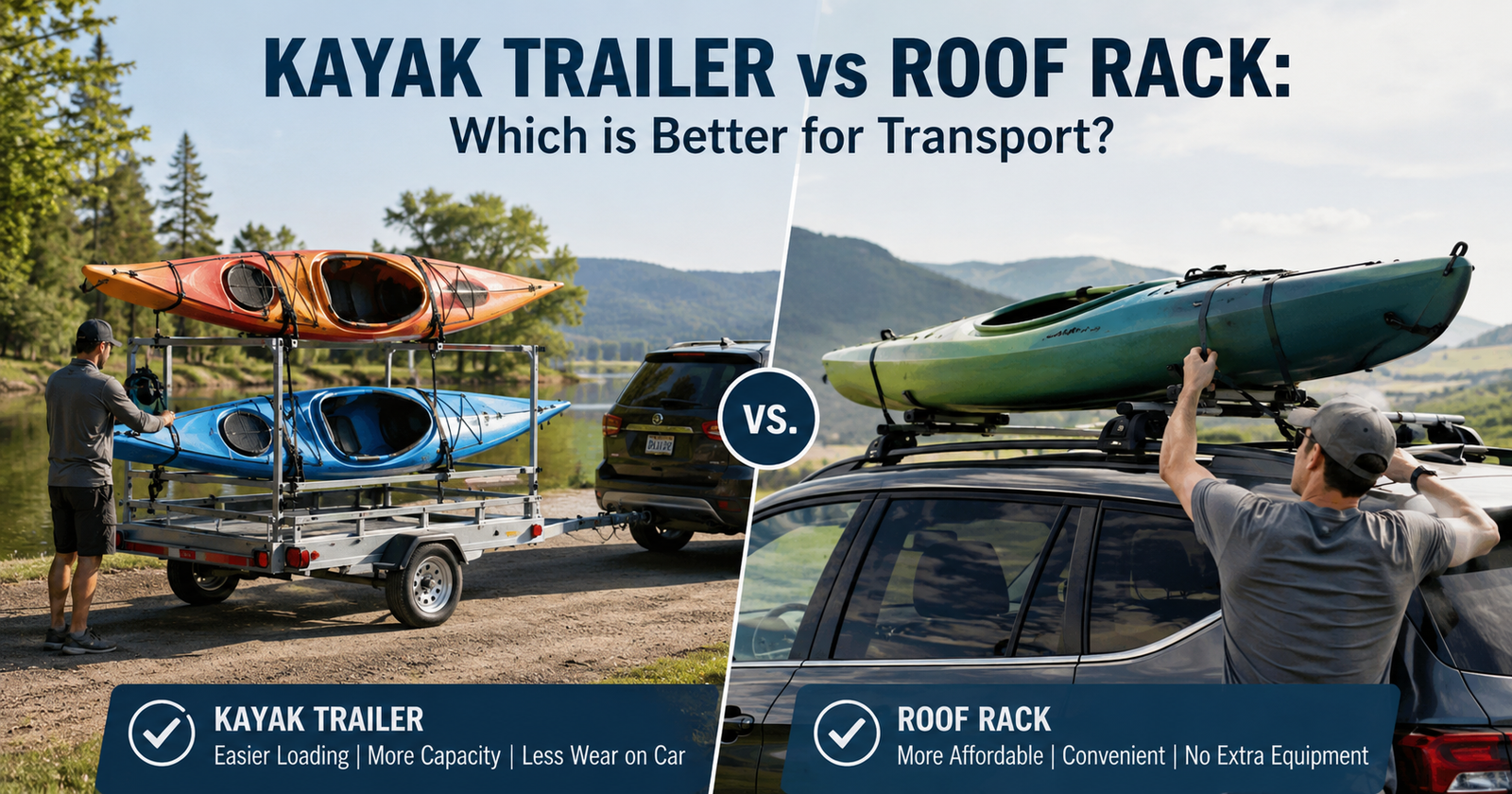
Getting a kayak to where you want to go safely is one of the most important parts of any paddling adventure. Whether you enjoy serene paddles around lakes, whitewater challenges, or coastal expeditions, getting your kayak to the water without damaging your vehicle or your equipment should always be a priority. Kayak Trailers and Roof Racks Two popular means of transportation. Both do the same job, but they are very different when it comes to convenience, cost, capacity, maintenance and how useful they are in the long run.
However, many first-time kayak owners think a roof rack is the obvious choice, simply because it’s more common. However, experienced paddlers who often travel long distances or who frequently carry several kayaks find that a dedicated trailer has its advantages. Your choice will depend on a host of factors, including your vehicle, budget, physical ability, storage space, and how often you kayak.
This detailed guide explains all the major differences between kayak trailers and roof racks to help you decide which one is better for your outdoor lifestyle.
Understanding Roof Racks
A roof rack is a set of mounts that go on top of your vehicle that allows you to secure your kayak using specialized carriers, J-cradles, saddle mounts or stackers. Sedans, hatchbacks, SUVs, pickup trucks, and many crossovers are available with roof racks.
For the casual paddler, roof racks are a great affordable option. Once installed, they take up very little storage space as they are permanently attached to the vehicle. This is a great investment because many outdoor enthusiasts use the same roof rack for bikes, cargo boxes, skis, snowboards, and surfboards.
Despite these advantages, lifting heavy kayaks onto the roof of a vehicle can be physically demanding, especially for solo paddlers or owners of taller SUVs.
Understanding Kayak Trailers
A kayak trailer is a trailer specifically designed for the transport of one or more kayaks behind a towing vehicle. Trailers sit much lower to the ground and don’t require you to lift kayaks overhead like roof racks do.
Today’s kayak trailers come in a variety of sizes and configurations, ranging from small single kayak trailers to professional, multi-level trailers that can hold eight or more kayaks. Some trailers can be folded for storage, and higher-end models feature lockable storage for paddles, life jackets and accessories.
Trailers are a larger initial investment and require more storage space, but they provide unbeatable convenience for frequent kayakers and families.
1. Ease of Loading and Unloading
One of the biggest differences between a trailer and a roof rack is how easy you can get your kayak loaded.
Roof racks require you to lift the kayak above shoulder height to properly place it on the crossbars. This can take two people depending on the weight of the kayak. Loading assist systems notwithstanding, getting a heavy fishing kayak onto the roof of an SUV can be a struggle.
Trailers though make it so much easier. They sit so much lower that you just have to lift the kayak a bit before securing it. This reduces the physical load and the chance of dropping or scratching your kayak.
Trailers make loading so much easier if you’re an older paddler, traveling with a family, or have back or shoulder issues.
2. Vehicle Compatibility
Most passenger cars can accommodate roof racks, as long as they have the appropriate roof rails or crossbars. If you have the right mounting equipment list, a compact car can often hold one or two recreational kayaks.
The vehicle should be able to tow trailers. While many SUVs, pickup trucks and crossovers will have no trouble towing a lightweight kayak trailer, some compact vehicles may not have the necessary towing capacity or the correct hitch installation.
If your current car is not a towing vehicle, a roof rack may be your only viable alternative.
3. Carrying Capacity
If you’re the kind of person who paddles alone or with one partner, a roof rack may be just the trick.
But, it’s a whole different story when you are transporting multiple kayaks.
Depending on the type of rack, the size of the vehicle and the weight limits of the roof, a typical roof rack will usually hold from one to four kayaks.
Depending on the design, kayak trailers can easily transport four, six, eight or even more kayaks. Outfitters, rental companies, clubs and large families often choose trailers because they can carry a lot more.
For group adventures or guided tours, a trailer wins out.
4. Long Distance Travel Performance
There are unique transportation challenges to long road trips.
A well-secured roof-mounted kayak increases wind resistance. Drivers generally report increased wind noise, slightly decreased fuel economy and an increase in crosswind effects at highway speeds.
Trailers do create their own aerodynamic drag but they generally keep the vehicle’s roof clear which makes highway driving easier. Plus, many paddlers like the option to retain their rooftop cargo boxes while towing kayaks behind the vehicle.
Kayak trailers are popular with the more experienced kayaker for frequent interstate travel because they are easier to load and allow you to keep your equipment handy at rest stops.
5. Fuel Efficiency
Another important consideration is fuel economy.
Roof mounted kayaks have a tremendous amount of drag because they are in the airflow directly. This typically translates to less highway fuel economy.
Trailers add rolling resistance and weight, but the kayaks still sit lower behind the vehicle. Fuel efficiency can vary widely depending on trailer design, vehicle type, travel speed and number of kayaks.
Sometimes, if you are making a local trip, it may not matter very much. Comparing the two systems: For frequent highway trips, transportation efficiency is more important.
6. Storage Requirements
Storage is often more influential in buying decisions than you may realize.
Roof racks are still fitted to the vehicle or can be removed and stored with relative ease in a garage.
And you’re going to need room for trailers. If you’re a homeowner with a large garage or driveway, you probably won’t have any issues storing them, but if you live in an apartment or have limited parking, owning a trailer can be a pain.
Consider where the trailer will be stored when you’re not using it before you buy one.
7. Initial Cost Comparison
The budget plays a significant role in the choice of transporting equipment.
Typically, a complete roof rack setup includes crossbars, towers, mounting hardware, and kayak carriers. Costs depend on the vehicle and manufacturer but a roof rack system is generally less expensive up-front than a trailer.
Kayak trailers are much more expensive, as they include wheels, suspension, lights, tires, frames and sometimes storage compartments. Depending on local regulations, registration and licensing requirements may also apply.
Trailers cost more upfront, but they can be more cost-effective in the long run for paddlers who frequently haul multiple kayaks.
8. Maintenance Requirements
Roof racks are fairly low maintenance. Normal maintenance consists of periodic inspection of mounting bolts, straps and carrier components.
Trailers require special attention. Tires should be properly inflated, wheel bearings checked, lights should work properly and moving parts possibly lubricated. Owners also should be on the lookout for rust, especially if the trailer is in saltwater environments often.
Maintenance is key to safety and longevity, regular maintenance.
9. Safety During Transportation
Properly installed roof racks are very safe if quality straps and bow and stern tie downs are used properly.
But if roof-mounted kayaks are not properly secured, they can move around, create dangerous wind lift or even come loose while driving.
Trailers also require solid tie-downs, but it’s usually easier to spot loading errors because the kayaks are still at eye level. Drivers should also remember that towing affects braking distance, turning radius and reversing technique.
Both modes of transportation are safe when used properly, but both require careful attention to manufacturer recommendations.
10. Convenience for Frequent Kayakers
The more you paddle several times a week the more important convenience becomes.
It gets tiring to lift heavy kayaks onto a roof over and over again. Over months and years many paddlers come to appreciate how fast trailers allow loading and unloading.
Many professional fishing kayaks weigh well over 80 pounds before you even add accessories. Even just putting these on a roof can be a pain.
Trailers reduce your prep time so you can use more energy enjoying the water.
Security Considerations
There’s always a security issue with leaving a kayak unattended.
The kayaks on the roof are very visible and might draw attention at the overnight stops. Locking straps and cable locks add an extra layer of security, but they don’t get rid of the risk of theft entirely.
Some enclosed trailers provide even more security and trailers may have integrated locking systems. However, quality locks benefit both modes of transportation whenever equipment is left unattended.
Which Option Works Best for Fishing Kayaks?
Fishing kayaks are getting bigger, wider and heavier. Many now come with pedal drives, fish finders storage systems and comfortable seats.
These additions make the roof loading much more difficult.
For serious kayak anglers trailers are often the best solution as they allow you to carry heavier boats without having to lift them overhead. Accessories can also be held in place during transit, reducing pre-launch setup time.
Which Option Is Better for Families?
Families often carry along several kayaks, as well as camping equipment, bicycles, coolers and luggage.
Roof racks fill up fast, especially on smaller vehicles.
Trailers offer far more flexibility as they can accommodate several kayaks, leaving the roof of the vehicle open for other cargo. This setup makes packing easier and allows for a more organized traveling experience.
Trailers tend to be the more practical long-term investment for growing families with multiple paddlers.
Choosing Based on Your Lifestyle
No one wins; everyone has their own priorities as a paddler.
If you paddle occasionally, have a small car, limited storage space and usually only carry one kayak, a roof rack is probably your best bet. It’s cheap, versatile and requires very little maintenance.
If you kayak often, have more than one kayak, often go long distances, or don’t like heavy lifting, a kayak trailer is unmatched in convenience despite the higher purchase price.
Choose a board that suits your current frequency of paddling and future outdoor activities.
Why Readers Trust Buzzplanets for Outdoor Buying Guides
It pays to do your homework before spending big bucks on kayak transportation equipment. Buzzplanets provides detailed reviews of outdoor gear, expert gear comparisons, maintenance tips and helpful buying advice for kayakers of all skill levels. Whether you are selecting your first roof rack, comparing trailer models, or searching for accessories to boost safety and convenience, Buzzplanets offers informative resources to guide you in making informed purchasing choices.
Conclusion
Kayak trailers and roof racks are great options for transporting when paired with the right user. Roof racks are still a budget-friendly, space-efficient option for recreational paddlers hauling one or two kayaks. They are easy to own, require little maintenance and work well for people with limited storage space.
Kayak trailers, on the other hand, are great for ease, capacity and loading. They are especially useful for families, fishing kayak owners, outdoor clubs and anyone regularly transporting multiple kayaks over long distances.
Instead of asking which is the better option overall, think about which is best suited to your vehicle, budget, storage space, and kayaking tips. Getting it right will make every trip from your driveway to the launch point better.
Frequently Asked Questions
1. Should I use a kayak trailer instead of a roof rack?
In general, a kayak trailer is better for carrying multiple or heavy kayaks, and a roof rack is better for occasional use and smaller budgets.
2. Will a small car pull a kayak trailer?
If you have a compact vehicle with the right capacity and a hitch, you can pull lightweight kayak trailers. Consult your vehicle manufacturer’s towing specifications.
3. Are roof racks bad for cars?
Roof racks do not damage vehicles when properly installed. If not installed correctly or overloaded, it can, however, cause scratches or structural problems.
4. Which option is safer for highway driving?
Both are safe if secured properly . The trick is to use good quality tie down straps, to check them regularly and to follow the manufacturer’s guidelines.
5. Which is more economical in the long run?
While roof racks usually involve out of pocket expense, for paddlers who regularly transport multiple kayaks, trailers may be more useful in the long run due to their convenience and added capacity.
Summary
Deciding between a kayak trailer or roof rack really depends on how often you kayak, what you need to transport, and what kind of vehicle and storage space you have. For the casual paddler roof racks are a cheaper and more space efficient and versatile alternative, while kayak trailers provide great loading convenience, higher capacity and more practicality for families and keen paddlers. Focusing on your long-term needs, and not just the purchase price, will help you select the mode of transportation that offers the best value in the long run.