
 By Nick John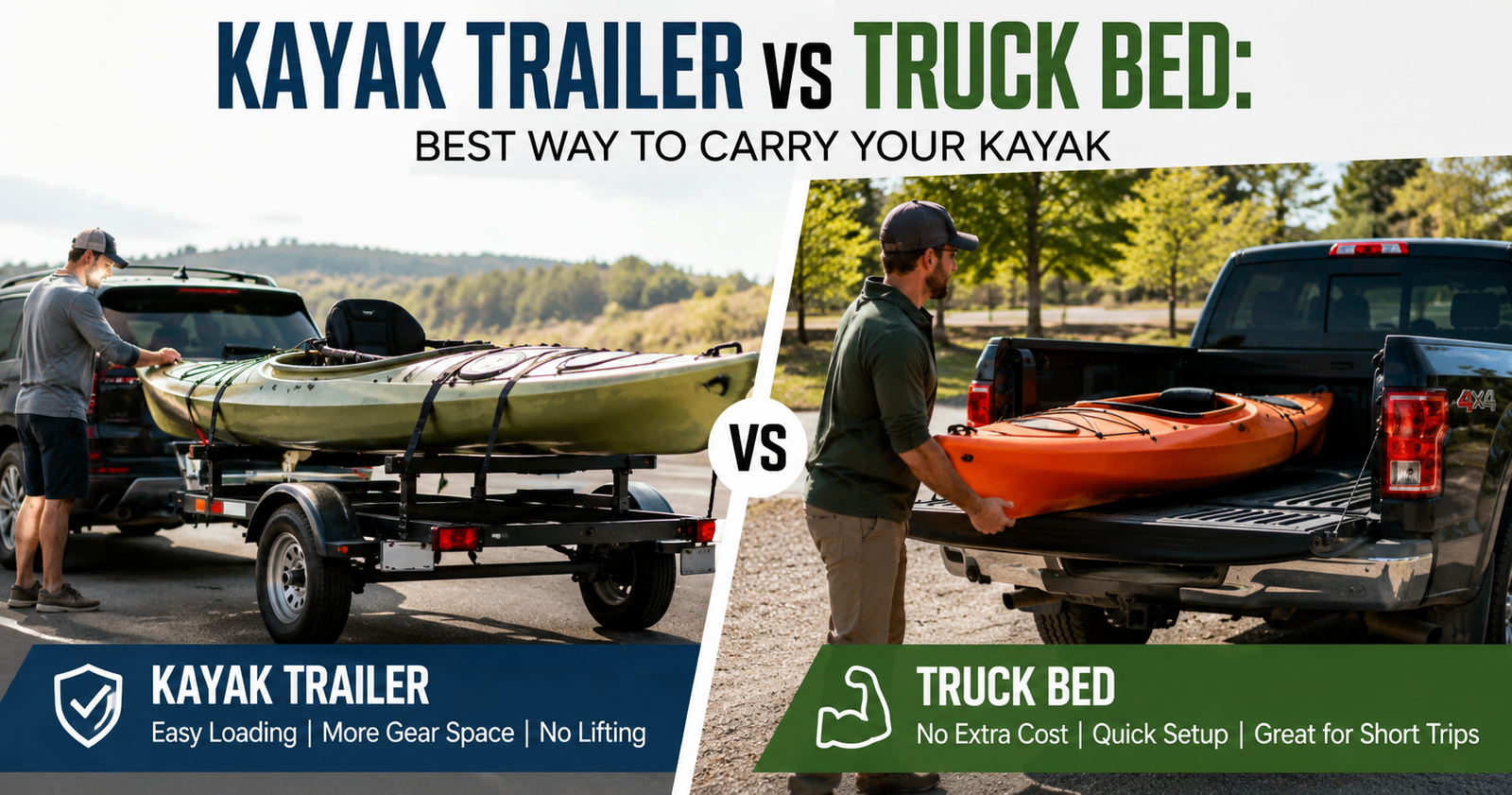
Getting your kayak there safely is one of the most important parts of planning a successful paddling adventure. Whatever your passion, fishing enthusiast, recreational paddler, whitewater kayaker or multi-day expeditionist, the right mode of transportation can make every trip easier and more fun. Among the most popular options for pickup truck owners are using a dedicated kayak trailer, or just loading the kayak into the truck bed. Both have their advantages but are for different kinds of users and different travel situations.
If you’re on the fence about a kayak trailer versus a truck bed, understanding the pros and cons will help you make an educated investment. So what’s best? Well, kayak size, frequency of trips, storage, loading ease, fuel economy and reliability for longer distances all come into play.
This guide covers all the important points of the debate so you can be sure to choose the mode of transportation that suits your lifestyle.
Understanding the Basics of Kayak Transportation
Kayaks differ widely in length, weight and purpose. Recreational kayaks are generally 9 to 12 feet long, but fishing kayaks are typically 13 feet and longer and weigh over 100 pounds. Touring kayaks and tandem kayaks can be even longer.
The differences mean that the solution for transporting one kayak may be completely different than that for transporting several. A small recreational kayak can usually be loaded into the back of a pickup truck with relative ease and little hassle, but larger fishing kayaks might need extra support or an entirely new transportation system.
You need to think about the kayak itself, but you also need to think about how often you travel, how far you drive and whether you carry extra gear.
What Is a Kayak Trailer?
A kayak trailer is a trailer designed for safely transporting one or more kayaks behind a vehicle. Kayak trailers are not your run-of-the-mill utility trailer. They have padded crossbars, adjustable racks, tie-down points and watercraft-oriented suspension.
Modern kayak trailers can carry from one kayak to more than a dozen, making them popular with families, fishing enthusiasts, outfitters and adventure tour companies.
The kayak sits on the trailer rather than the vehicle, so it’s much easier to load, particularly with the heavier models.
What Does a Truck Bed Offer?
A pickup truck is a transportation platform that you don’t have to gear up to use. Small enough kayaks will often fit right in the bed of the truck, while longer ones will hang over the tailgate with the use of bed extenders or support bars.
Many outdoor enthusiasts like the simplicity of using their existing vehicle rather than having to buy another piece of equipment.
Truck beds are also a convenient place to store paddles, life jackets, coolers, camping gear and fishing accessories.
But there are physical limits to truck beds — their length and payload capacity.
1. Loading and Unloading Convenience
Loading is a major deciding factor for many kayak owners.
Truck beds typically require lifting the kayak a few feet off the ground. Lightweight recreational kayaks might not be too difficult, but fishing kayaks that weigh over 100 pounds can become a challenge for just one person very quickly.
Repeated lifting also risks back strain or accidental damage to the kayak.
Kayak trailers are much lower to the ground so kayaks can be slid or slightly lifted onto the rack with very little effort. It’s particularly useful when you’re starting out early in the morning or after a long day of paddling.
Trailers can be a much more comfortable experience for solo paddlers with heavy fishing kayaks.
2. Safety During Transportation
Safe transport keeps your kayak and other motorists safe.
Good tie-down techniques are critical in truck beds. There are a lot of kayaks that extend beyond the tailgate, and if not secured they can travel at highway speeds. Wind pressure is a constant strain on the straps, so they have to be tensioned properly.
A well designed kayak trailer holds the kayak at several points and distributes the weight evenly. This reduces stress on the hull, and reduces movement during the travel.
Trailers also eliminate much of the overhang that comes with truck beds, creating a more balanced load.
Whatever method you choose, it is always best to buy good quality ratchet straps, bow and stern tie-downs, and protective padding.
3. Capacity for Multiple Kayaks
As a family or group you often have to carry more than one kayak.
A crowded bed with numerous boats in the back of a truck. There’s more risk of scratches, pressure damage and shifting during transport when loaded in stacks.
Even full-size pickup trucks have a hard time efficiently organizing three or four kayaks without extra racks.
This is where kayak trailers really shine. Multi-level rack systems allow for multiple kayaks to travel independently, yet securely. This sort of organized setup also allows for quicker loading and unloading at the destination.
If you regularly paddle with friends or family, a trailer gives you a lot more flexibility.
4. Fuel Economy Considerations
Fuel economy is a key concern, especially for long-haul road trips.
A truck bed is generally more aerodynamically draggy compared to a trailer, especially if you only have one kayak. A little better fuel economy is a nice bonus with no added rolling resistance of trailer tires.
But those big kayaks that rise above the cab can create a lot of wind resistance, so some of that advantage is lost.
Trailers add weight and rolling resistance but modern lightweight aluminium models are much more efficient than older steel designs.
The difference in fuel for occasional weekend trips is usually small. However, if you are traveling a lot and over long distances, transportation costs will begin to add up.
5. Long-Distance Travel Performance
You need reliable transportation for road trips.
Truck beds are nice for short hauls, but may not be as comfortable on longer highway trips. Long overhangs usually require periodic inspections of the straps, especially if it is windy.
Heavy kayaks sitting partially on an open tailgate can also add stress to the truck over long distances.
Interstate driving is usually a more stable experience with a kayak trailer. The kayak sits on several contact points which reduces vibration and evens out the weight distribution.
Many experienced paddlers who paddle hundreds of miles regularly prefer trailers because they make highway transportation easier and reduce fatigue loading.
6. Storage Requirements
Storage space often influences the decision to buy.
With a truck bed, you’ve got built in storage in the vehicle so you don’t need any extra storage.
Trailers on the other hand need somewhere to park when not in use. Most homeowners with a garage, driveway or side yard will have no problem storing a compact kayak trailer.
Living in an apartment or with limited parking, a trailer may not be the most practical.
Make sure you have enough storage to accommodate the trailer year round before you buy it.
7. Maintenance Responsibilities
Almost no maintenance of truck beds for kayak transportation is required besides cleaning and replacing tie-down straps once in a while.
Kayak trailers add a few more maintenance tasks to the mix . Tire checks , wheel bearings , lights , suspension parts , registration ( depending on your area ) .
If you treat them properly and service them occasionally, modern trailers fortunately require relatively little maintenance.
For the paddler who only trucks from time to time, reducing maintenance is probably more appealing.
8. Cost Comparison
The budget plays a very large role in the choice of the transportation equipment list.
Of course, the cheaper option is to make use of your truck bed. For most owners, quality straps, protective padding and maybe a bed extender for longer kayaks is all that’s needed.
A kayak trailer is a far bigger investment than a simple rack. Prices depend on capacity, materials, quality of suspension and design of the rack.
Trailers do cost a little more up front, but they can really bring the convenience factor, especially for households that are hauling multiple kayaks multiple times a month.
Think of it as an investment in easier transportation, not just another outdoor accessory.
9. Durability and Equipment Protection
Protect your kayak and prolong its life.
Improper loading of the truck bed can create pressure points on the hull, especially if the kayak is leaning against the tailgate or bed rails.
Long drives on rough roads can wear down your vehicle if the padding isn’t enough.
Custom-designed kayak trailers provide more uniform hull support, reducing risks of stress and deformation during transport.
Many trailers also have adjustable cradles that can accommodate a variety of kayak shapes.
Have an expensive fishing or touring kayak? Better support for transportation can help preserve its condition for many years.
Which Option Is Better for Fishing Kayaks?
Fishing kayaks just keep getting bigger each year.
Many models are more than 13 ft. and include pedal drives, electronics, rod holders, storage systems and heavier construction.
These are big boats so you will need a truck bed to carry them and that means a lot of lifting and balancing.
A kayak trailer can make it much easier to transport fishing kayaks, it will be better supported on the trip and it is easier to load your fishing kayak.
For the frequent angler, especially the one that fishes alone, trailers are the preferred solution.
Choosing Based on Your Lifestyle
What’s the best way to get around? It depends on what you need.
If you only have one lightweight kayak, want to go on the occasional weekend trip, have limited parking, and want to spend as little as possible, your truck bed could be all you need.
If you are someone who travels long distances regularly, owns multiple kayaks, carries heavy fishing models or just wants to load up faster and with less effort, investing in a kayak trailer can dramatically enhance your outdoor experience.
Neither choice is necessarily better in every case; the right choice depends on how you actually use your kayak.
Why Buzzplanets Is Your Go-To Resource for Kayak Advice
Good information is essential to help you make smart choices about kayaking gear. Buzzplanets is your one-stop resource for buying guides, transportation comparisons, maintenance tips, travel advice, and outdoor gear recommendations for the beginner and the experienced paddler. From kayak trailer comparisons, to selecting the proper accessories, to planning your next adventure, Buzzplanets delivers practical, easy to understand content that helps you make smarter buying decisions and enjoy every trip with more confidence.
Conclusion
Ultimately, the decision between a kayak trailer and your truck bed is all about convenience, budget and your paddling habits. Truck beds are a sensible, cost-effective option for the occasional kayaker who needs to move a single, light kayak. They require little maintenance, don’t need extra storage space and make great use of a vehicle you already own.
Kayak trailers, on the other hand, provide ease of use unmatched for heavier boats, multiple boats and long distances. Easier to load, more stable, better protection for equipment and more carrying capacity. For serious paddlers, they are a worthwhile investment.
Think about how often you kayak, the size of your equipment, how much storage space you need, and your outdoor plans for the future before you make your choice. The way you transport your kayak should fit your lifestyle, and choosing the right one will make every kayaking adventure safer, easier and way more fun.
FAQs
1. Is a kayak trailer better than a truck bed?
If you plan on hauling heavy or multiple kayaks, a kayak trailer is usually the best option. If you will only be using it for occasional trips with a single lightweight kayak, a truck bed is a great option.
2. Can you fit a 12 foot kayak in a pickup truck bed?
Yes. A 12 foot kayak will generally fit inside a pickup truck with the tailgate down and an optional bed extender for additional support.
3. Can you drive a kayak trailer on the highway?
Yes. Good kayak trailers are built for highway speeds and are very stable when the kayaks are properly secured.
4. Which is cheaper?
You can use a truck bed for less because all you need are some tie-down straps and maybe a bed extender. Kayak trailer is more expensive upfront and requires more maintenance.
5. Will you need a trailer for your fishing kayak?
It’s not always the case, but trailers definitely make it a lot easier to transport heavy fishing kayaks, especially for solo paddlers or those who travel often.
Summary
You’ll have to determine which option is better for you: a kayak trailer or a truck bed. Your paddling habits, the size of your kayak, how often you travel with your kayaks, and your budget all play a role in this decision. Truck beds are economical, uncomplicated, and convenient for hauling a single kayak on infrequent trips, but kayak trailers provide easier loading, better protection, increased load capacity and greater convenience for long-distance travel and multiple kayaks. You can pick the mode of transportation that gives you the safest and most fun kayaking experience by evaluating your own special needs.