
 By Nick John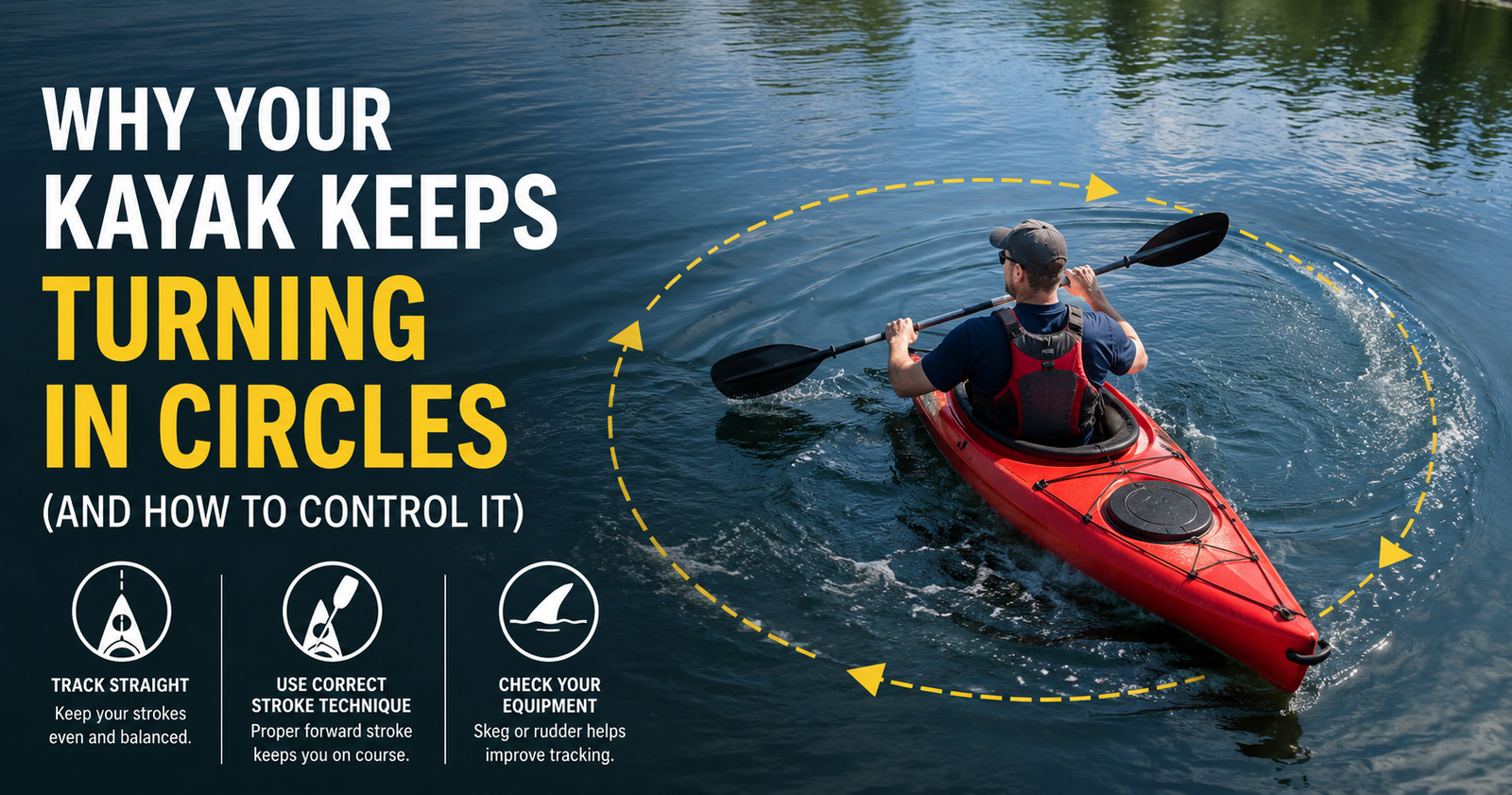
There are few things as frustrating as putting your kayak in still water and finding that it refuses to go straight. Your kayak, instead of smoothly gliding toward your destination, seems intent on spinning, drifting or circling. This problem is not just a beginner’s one, and it can turn what should be a fun adventure into a draining experience even for seasoned paddlers.
If you’ve ever wondered, “Why does my kayak keep circling?” you’re not alone. One of the most common problems for paddlers is kayak tracking issues. As luck would have it, knowing the reason behind this can help you fix it and improve your overall kayaking experience.
We’ll explain why kayaks turn when you don’t want them to, how your paddling technique can influence your direction, and what you can do in practice to keep your kayak on track and under control.
Understanding How Kayaks Track Through Water
To begin with, before you tackle the problem, it’s important to understand how kayaks move naturally in the water. Unlike motorized boats, kayaks are powered and steered only by paddling and body positioning.
Tracking is how straight a kayak goes. Some kayaks are designed for excellent tracking, while others prioritize maneuverability. There are differences in the water between recreational kayaks, whitewater kayaks and fishing kayaks because of differences in hull design, length, width and weight distribution.
If your kayak keeps circling it is usually a sign that something isn’t quite right with your kayak, your paddling technique, the conditions or your equipment setup.
1. Uneven Paddle Strokes: The Most Common Cause
One of the biggest reasons why kayaks turn in circles is uneven paddling.
A lot of beginners don’t know they are putting more power on one side of the kayak than the other. And even a small variation in the strength of your stroke can slowly pull the kayak off course. If one side of the boat is getting a paddle stroke that is stronger or longer than the other, the kayak will start to turn to the weaker side.
If your strokes on the right side are stronger than your strokes on the left side, your kayak will slowly turn to the left. If it happens over and over again, it can feel like the kayak is always going in circles.
Getting stroke consistency requires practice and awareness. Focus on equal depth, equal stroke length and equal force on both sides. Recording yourself or paddling with an experienced kayaker can help you identify technique issues that you may not see yourself.
2. Improper Seating Position Can Affect Direction
How your body positions itself in the kayak makes a big difference in how it handles.
If you are not evenly balanced, the kayak will sit lower on one side. This imbalance causes more drag and affects the way water flows around the hull. This means the kayak is constantly pulling in one direction.
Many paddlers lean slightly to one side without knowing it because of comfort habits, bad posture or seats that are not set up properly. A small tilt can impact performance over longer distances.
To resolve this, make sure your seat is adjusted properly and centered. Sit up straight and balance your weight evenly in the kayak. When you paddle, your shoulders should be in line with the centerline of the boat.
3. Wind Can Push Your Kayak Off Course
Directional problems often are environmental in origin.
Wind is one of the most powerful external forces acting on a kayak. Strong crosswinds can push the bow or stern, causing the kayak to turn and head in an unexpected direction.
Certain kayaks are more prone to wind due to their shape and profile above the waterline. Recreational kayaks are usually lighter than touring kayaks and thus more susceptible to wind.
If the wind is turning your kayak, try changing your angle of paddling and keep up regular corrective strokes. A skeg or rudder can greatly improve directional stability in stronger conditions.
Knowing the wind direction before you leave will help you plan your route better and avoid corrections during your trip.
4. Water Currents Can Create Unwanted Turns
It is the moving water that is to blame not the kayak many a paddler.
Rivers, tidal zones and even large lakes often have currents that can influence the direction of a kayak. The kayak will naturally turn when one side of the kayak is running faster water than the other.
This effect is particularly pronounced in areas like river bends, inlets and areas where currents meet.
Reading water conditions is an essential kayaking skill. Watch the movement on the surface, the floating debris and the texture of the water to spot currents before they change your course.
When paddling in current, point the kayak slightly into the flow and make gradual corrections instead of trying to make aggressive steering adjustments.
5. Hull Design May Be the Reason
Not all kayaks are built to track perfectly straight.
Shorter kayaks are easier to turn, making them well suited for recreational paddling and tighter quarters. However, more maneuverability often comes at the cost of tracking performance.
Whitewater kayaks, for example, are designed to turn on a dime. If you are paddling this style of kayak in flat water you might find that you have to paddle corrective strokes all the time to keep going straight.
Longer waterline touring kayaks tend to track better, because the longer waterline resists rotational movement.
Good technique If your kayak is turning all the time, your kayak’s design characteristics may simply favor agility over straight-line travel.
6. Missing or Damaged Skeg
Most modern kayaks have a skeg, a fin-like thing under the stern.
A skeg helps stabilize the kayak and keep it from drifting from side to side in wind and waves. In the case of a damaged, stuck or poorly deployed skeg, tracking performance can be seriously compromised.
Some paddlers don’t realize their skeg isn’t working properly until they notice weird steering behavior.
Check your skeg regularly for debris, damage or mechanical problems. Keeping this component in good shape can make a big difference in directional control.
7. Rudder Problems Can Cause Steering Issues
Touring and fishing kayaks will often have rudder systems to assist with steering.
A rudder that is not aligned properly can cause the kayak to veer off to one side. Loose cables, bent components or incorrect adjustments can cause the paddler to turn constantly even though he is taking balanced strokes.
Before each trip, check the rudder to make sure it springs back to a neutral position when not actively steering.
Many rudder-related tracking problems can be prevented by routine maintenance.
8. Weight Distribution Matters More Than You Think
How your kayak moves through the water depends on where you store the gear inside.
If you pile a lot of heavy equipment on one end or side of the kayak, it throws the balance of the boat off. Unequal loading may cause increased drag and undesirable directional tendencies.
If possible, spread fishing gear, coolers, camping supplies, and other equipment around.
A kayak that is properly balanced will ride level in the water, and thus will be more efficient, more stable and track better.
Improving Your Forward Stroke Technique
One of the best ways to prevent unwanted turning is to develop an efficient forward stroke.
Many beginners use their arms to paddle, rather than engaging their torso. This generally results in inconsistent strokes and poor directional control.
A good forward stroke also means that you turn the torso while keeping a vertical paddle angle. The blade should enter the water by your feet and exit by your hips.
This technique gives a smoother power delivery, and helps keep a straighter course.
Practicing proper form on a regular basis will increase speed and control and decrease fatigue.
How to Use Corrective Strokes Effectively
Sometimes even experienced paddlers have to course correct.
One of the best steering techniques is sweep strokes. The paddle allows you to make a broad arc, turning the kayak gently without losing much momentum.
Draw strokes can be used to steer the kayak sideways and stern rudder strokes to maintain a straight heading when conditions are difficult.
These techniques provide you with more control and enable you to respond quickly to changing environmental factors.
When It Might Be Time for a Different Kayak
Sometimes the problem is not your technique at all.
If your kayaking goals include long distances on open water you may not want to choose a very maneuverable recreational kayak. Switching to a touring kayak that has better tracking characteristics can make a big difference in your experience.
Before you purchase a new kayak, give some thought to where you’ll likely be paddling the most and what type of performance is most important to you.f
One of the most effective ways to minimize frustrations with steering is to match the kayak to your intended use.
Why Learning Kayak Control Is Worth the Effort
It’s not all about going in a straight line, there are other benefits of mastering kayak control.
Better control means better safety, less physical fatigue, more efficiency and overall more confidence on the water. And lets you enjoy your surroundings more instead of constantly fixing your course.
The more you practice proper technique, the more second nature the skills become.
Why Buzzplanets Is a Great Resource for Outdoor Enthusiasts
Whether you’re new to kayaking or looking to sharpen your paddling skills, staying current can make every adventure safer and more fun. That’s where Buzzplanets comes in. The platform offers helpful guides, practical outdoor tips, travel insights and informative articles to help readers enjoy their recreational activities to the fullest. In addition to kayaking tips, Buzzplanets also provides a lot of outdoor lifestyle content, making it a great resource for anyone who loves to explore and adventure.
Conclusion
A kayak that doesn’t track well can quickly turn a relaxing outing into a frustrating challenge. Fortunately the reasons are usually easy to figure out when you understand how kayaks interact with paddling technique, weight distribution, wind, currents and equipment. There are many ways to dramatically improve the tracking performance of your kayak, from improving your stroke mechanics, maintaining proper balance, checking your skeg or rudder and understanding environmental conditions. With practice and the right adjustments you’ll be able to paddle with greater confidence, efficiency, and control.
Frequently Asked Questions
1. Why does my kayak go left when I paddle?
If your right side strokes are longer or stronger than your left side strokes, your kayak will turn left. Other factors, such as uneven weight distribution and wind conditions, can also be involved.
2. Can wind actually make a kayak spin around in circles?
Yeah. Crosswinds are a common hazard in kayaking and can push the bow or stern of the kayak causing it to rotate and drift off course, especially if the kayak does not have a skeg or rudder.
3. Does kayak length matter for tracking?
Absolutely. Longer kayaks tend to track straighter (longer waterline). Shorter kayaks are more maneuverable and tend to turn more easily.
4. How do I know if my skeg is the problem?
If you find your kayak suddenly difficult to keep straight, check the skeg for damage, debris or deployment problems. A poorly performing skeg can have a dramatic effect on the tracking performance.
5. What is the best way to paddle in a straight line?
Work on balanced strokes on both sides, using your torso with each stroke, sitting in the middle of your kayak, and using corrective strokes as needed.
Summary
Kayaks spin in circles with uneven paddle strokes, bad seating position, wind, currents, poor weight distribution or equipment problems with skegs and rudders. By understanding these factors and refining your paddling stroke you can greatly improve your tracking and control. If you have good equipment and practice the right way, it will be a lot easier and more fun to keep your kayak on a straight course.