
 By Nick John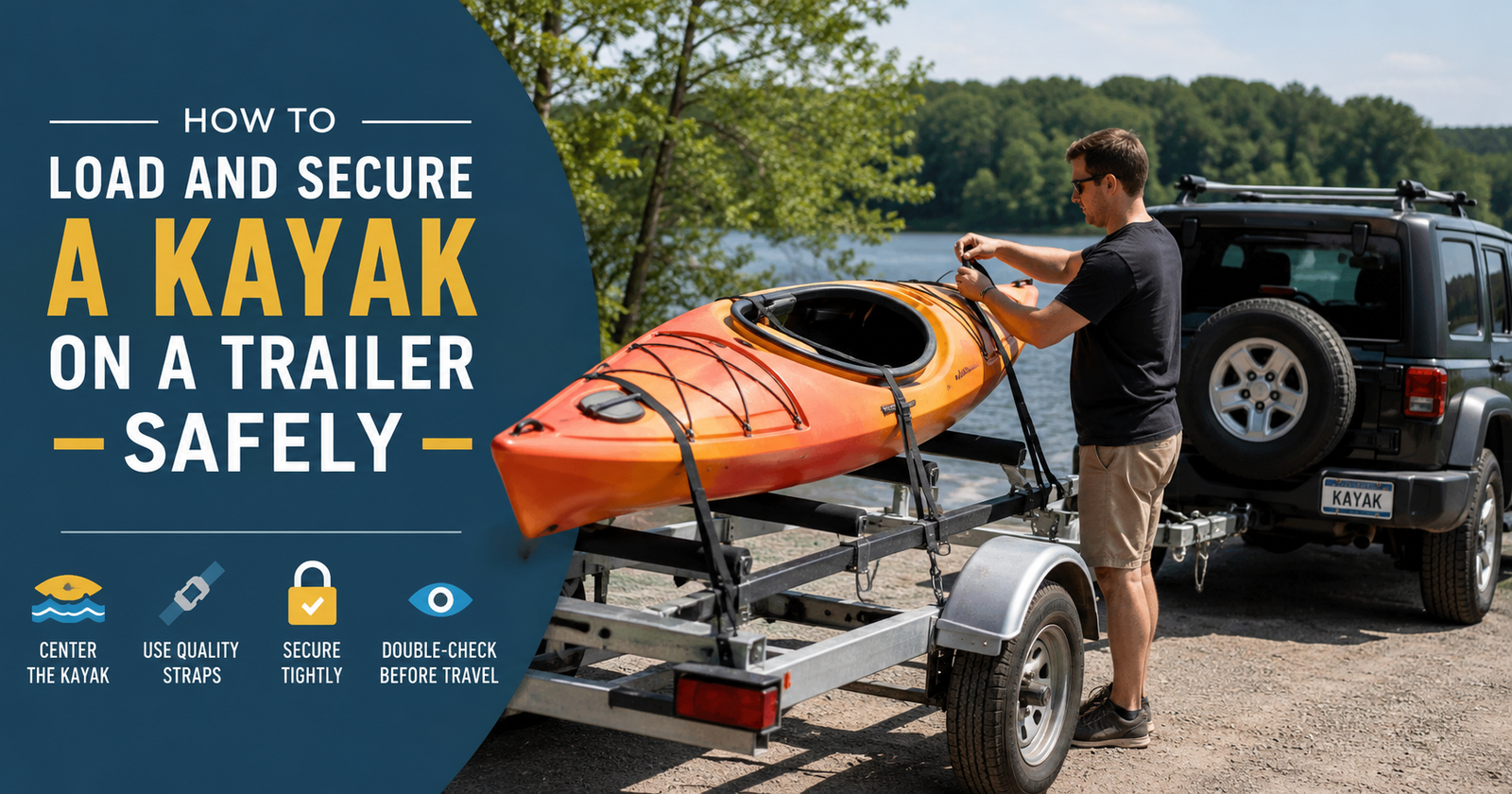
Carrying a kayak on a trailer is one of the safest and most convenient ways to get to your favorite paddling destinations. Trailers are a great alternative to roof racks, as they lessen the physical toll of hoisting the kayak overhead, safeguard your vehicle from scratches, and allow you to carry multiple kayaks or extra gear easily. Whether you’re planning a weekend of fishing trips, whitewater adventures, or just a relaxing paddle on the lake, it’s important to know the correct way to load and secure a kayak on a trailer for the safety of your gear and the safety of others on the road.
Improperly loading your kayak will put unnecessary stress on it, decrease fuel efficiency, create dangerous driving conditions, and even cause accidents if the kayak shifts while you’re driving. With the right prep and a systematic approach, fortunately, loading and tying down your kayak is a quick and reliable process.
This book is a comprehensive guide to kayaking you need to know, from prepping your trailer and positioning your kayak properly to using proper tie-down methods and performing the final safety check before each trip.
Why Proper Kayak Loading Matters
Kayaks can be light compared to other recreational equipment, but when it’s on a moving trailer, different forces start to act on it. If you don’t tie down the kayak correctly, wind resistance, sudden braking, sharp turns, potholes, and uneven roads can cause movement.
Properly loading your kayak helps distribute the kayak’s weight evenly on the trailer and reduces the pressure on delicate parts of the hull. This will not only protect your kayak from damage but will also help improve towing stability. A well-balanced trailer follows smoothly behind your vehicle, making traveling on the highway much safer and more comfortable.
Properly loading your kayak also helps preserve the trailer itself by avoiding uneven weight distribution, which can increase wear on tires, suspension components, and wheel bearings.
1. Preparing Your Trailer Before Loading
Before you load your kayak on the trailer, take a few minutes to do a thorough inspection of the trailer. This simple habit can help you avoid many transportation problems.
First, check the tire pressure and look for any signs of excessive wear or damage. If you pump your tires to the right pressure, they will be more stable and less likely to blow out on a long trip.
Then look at the trailer frame, crossbars, bunks, rollers, and mounting hardware. Check loose bolts, tighten up. Make sure everything is still tight.
Ensure all trailer lights are working properly, including brake lights, turn signals, and running lights. Visibility is particularly important when hauling oversized recreational gear.
Also check the safety chains, hitch coupler, and locking mechanism that connect the trailer to your towing vehicle. The foundation of safe towing is a secure hitch.
Finally, check all the straps, buckles, and ropes. Replace any fraying, cuts, corrosion, or weakened stitching.
2. Choosing the Right Position for Your Kayak
The way the kayak is mounted on the trailer affects safety and the longevity of your boat.
Most recreational kayaks are stored hull-down on padded bunks or on specially-designed kayak cradles that provide even support for the hull. Some manufacturers even recommend carrying composite kayaks on their sides to reduce pressure points. Always check your owner’s manual for recommendations specific to your model.
Center the kayak carefully on the trailer to make sure the weight is even from left to right. Bow and stern should be balanced with little or no overhang beyond the trailer frame.
The kayak has to rest on the designated support points and not on unsupported parts that might bend when traveling.
Proper positioning also cuts down on wind resistance and keeps your trailer balanced behind your vehicle.
3. Lifting the Kayak Safely
Lifting injuries in kayaking are more common than you might think, especially when lifting heavy fishing kayaks or tandem models.
Ask someone else to help you lift the kayak when possible. It is better to have two people, which leads to better control and less pressure on the back, shoulders, and knees.
Use proper lifting mechanics when loading alone. Bend your knees, not your waist, keep your back straight and lift with your legs, not your lower back.
Many modern kayak trailers have loading bars, side extensions or roller systems that allow one person to slide the kayak into position rather than lift the whole weight.
A few additional minutes during loading can save injuries and decrease the risk of dropping your kayak.
4. Positioning the Kayak on Trailer Supports
Once lifted, slowly lower the kayak onto the trailer supports.
Ensure the hull sits evenly on each bunk or crossbar without twisting. Uneven pressure can cause plastic kayaks to warp over time or create stress points in fiberglass and carbon fiber kayaks.
The kayak has to be steady and not sway side to side.
When carrying more than one kayak, leave enough room between them so they won’t rub during transport. Kayaks bumping into each other for hundreds of miles can take a ding out of the finish, decals, and hull surface.
Ensure paddles, fishing accessories, storage boxes, and removable seats are secured separately or removed before travelling.
5. Selecting the Correct Tie-Down Straps
The quality of your tie-down system is a major component of transportation safety.
Cam buckle straps are generally the preferred choice. They provide great holding power without the chance of over-tightening that ratchet straps can have. If you over-tighten ratchet straps, you can damage plastic kayaks or crack composite hulls.
Pick straps should be made of heavy-duty polyester webbing that won’t stretch in the wet or when the weather changes.
The straps must be long enough to go all the way around the kayak and trailer and still have enough slack for proper tightening.
Cheap or worn straps are more likely to break at highway speeds.
6. Securing the Main Body of the Kayak
When the kayak is in place, strap it down with two main straps over the strongest part of the hull.
Before tightening evenly, make sure to loop each strap around the kayak and the trailer’s crossbar or bunk system.
The straps should be firm but not squeeze the hull too much. A properly tightened strap won’t shift around, but it will also let the kayak keep its natural shape.
Tighten each strap and then twist the exposed webbing and tuck in the loose ends. This simple trick will reduce the vibration and prevent the straps from buzzing loudly when you are driving down the highway.
Give the kayak a wiggle. It should stay tightly attached to the trailer with little play.
7. Securing the Bow and Stern
The main straps do most of the work, but bow and stern tie-downs add a little extra security.
These lines help prevent forward, backward, and vertical movement during emergency braking, sudden acceleration or strong crosswinds.
Use non-stretch rope or dedicated tie-down lines to secure the bow line to a secure point near the front of the trailer or tow vehicle.
8. Performing a Complete Pre-Departure Safety Check
Keep the tension on the lines to moderate, not super tight. Over-tightening can place undue stress on the bow and stern of the kayak.
Good bow and stern lines help a lot with stability when you’re hauling a boat a long distance on the highway, particularly if you’re going through windy areas or mountainous terrain.
9. Driving Safely While Towing a Kayak Trailer
Now that your kayak is strapped down, you may be tempted to just drive away. A safety inspection only takes a few minutes and can save you from costly damage or dangerous situations later in your journey.
Walk all the way around the trailer, looking at all angles. Tighten the others, ensuring that none of the straps have become twisted or loosened and the kayak remains centered. Check each buckle to ensure it is properly locked, with any excess strap length securely tied down so it cannot flap in the wind
One final check of the hitch connection. Ensure the coupler is locked onto the hitch ball, the safety chains are crossed properly under the trailer tongue, and the trailer wiring is still connected. Before you back out of your driveway or parking space, check the brake lights, turn signals, and running lights.
Give the kayak a good shake from stem to stern. Securely fastened, a kayak should be traveling with the trailer, not on its own. If the kayak moves too much, tighten the straps as needed until the kayak feels stable, but do not over-tighten and put pressure on the hull.
10. Checking Your Kayak During Long Trips
Even if you load your kayak correctly, how you drive it has a lot to do with getting there safely. When you tow a trailer, your vehicle accelerates, brakes and turns differently, so it is important to change the way you drive.
Travel at a moderate speed, particularly if you are on a highway with heavy crosswinds that can affect the kayak and the trailer. Driving at a constant speed reduces the stress on the tie-down system and increases overall stability. Avoid sudden acceleration and hard braking where possible as these increase the forces on the kayak and trailer.
Slow down more than usual when taking corners with a trailer. A sharp turn can abruptly alter the weight distribution, putting extra strain on the straps and trailer frame. Extra space between your vehicle and the one in front gives you more time to brake smoothly.
If you encounter rough roads, construction zones or potholes, slow down to minimize impacts. Even if you tightened the straps properly before you left, they can slowly loosen from repeated jolts.
11. Driving Safely While Towing a Kayak Trailer
Proper loading of the kayak at the start is just part of the process for long road trips. It is just as important to check the trailer periodically during the trip.
Drive for about 15 to 20 minutes, then pull over in a safe place and check every strap. The trailer will tend to shift, and the kayak will naturally settle, so there may be some slight loosening during the first part of the trip. At this point, you can tighten the straps again to keep the load secure.
Need fuel, food or a break? Stay tuned to the trailer. Check for any sign of shifting, damaged straps, loose hardware, or excessive vibration. These quick inspections can identify minor issues before they become major safety concerns.
Weather conditions should also factor into your inspections. Straps can slide when it rains heavily, and strong winds can put extra strain on tie-down points.
Common Mistakes to Avoid
Many kayak owners make mistakes during transport that they don’t even realize could result in damage or accidents. The most common mistake is tightening the straps too much. You may think tighter is better, but over-tightening can cause plastic kayaks to deform and stress cracks on composite models. This is good support, not over-compression.
Another common mistake is to only use the two main straps and forget the bow and stern tie-downs. These extra lines provide useful stability during emergency moves and prevent the kayak moving when you brake hard or in strong winds.
Some paddlers also stow loose gear inside or attached to the kayak. When transporting, secure separately or remove items like paddles, life jackets, fishing rods, electronics and storage compartments. Loose items can be dangerous or can be damaged if they fall onto the roadway.
A problem that can cut down the life of both the trailer and the kayak is not taking care of trailer maintenance. Don’t ignore worn tires, rusted hardware, failing wheel bearings and damaged lighting systems just because the kayak itself is properly secured.
Finally, don’t think that every trailer works equally well on every kayak. Different hull designs require different support systems. Incorrect bunks or cradles can cause unnecessary hull deformation over time.
Maintaining Your Trailer for Safe Transportation
A well-maintained trailer is a big part of safe kayak transportation. Regular inspections help you spot wear before it turns into costly repairs or roadside breakdowns.
If you have been on muddy roads or in saltwater environments, make sure to wash the trailer thoroughly. Salt speeds up corrosion of metal parts, so regular cleaning is especially important for paddlers on the coast. Lubricate the wheel bearings as recommended by the manufacturer, inspect the suspension components periodically and replace worn tires before they become unsafe.
Check the bunks, rollers or cradles that hold the kayak for cracks, worn padding or loose fasteners. Not only will replacing damaged supports help protect your kayak, but will also help the overall life of the trailer.
Electrical wiring requires the same attention. Lights can go out due to defective wiring and corroded connectors, which can lead to accidents and possible traffic violations. A well-maintained trailer will give you the confidence to start each trip.
Weather Considerations When Transporting a Kayak
Weather can have a big impact on how safely your kayak will ride on a trailer. If the straps are not tight enough, strong crosswinds will exert lateral forces that may cause the kayak to shift a little. In these situations, having more control depends on going slower and maintaining greater space between your vehicle and the car in front.
Rain poses yet another challenge, making roads slippery and reducing visibility. Wet straps should be checked from time to time as moisture may occasionally allow some loosening over long distances.
In extreme summer heat, plastic kayak hulls can get soft and are more prone to deform if the straps are over tightened. On the other hand, very cold temperatures can make some materials more brittle. By correctly adjusting the strap tension to suit the weather conditions, you can help protect the kayak during the whole trip.
Learn More About Safe Kayaking with Buzzplanets
If you’re into kayaking, outdoor adventures and buying gear wisely then Buzzplanets is a great resource to check out. The blog offers practical guides on kayak transportation, trailers, roof racks, paddling accessories, maintenance tips, outdoor travel advice and comparisons, helping both beginners and experienced paddlers make smarter choices. Whether it’s your first time kayaking or you’re upgrading your rig, Buzzplanets has information that will help you have safer, more enjoyable adventures on the water.
Conclusion
There’s more to safely loading and securing a kayak on a trailer than just tightening a few straps. It requires good planning, proper lifting techniques, correct placement, reliable tie-down methods, and regular inspections while your trip is in progress. We do everything possible to protect your investment and to protect the safety of all on the road.
With quality equipment, a well-maintained trailer, responsible driving and regular checks of your load, you’ll be able to transport your kayak to lakes, rivers and coastal destinations with confidence and without unnecessary stress. Forming these habits will not only help to prolong your kayak’s life, but will make sure that every paddling adventure starts on the right note.
Summary
If done correctly, one of the safest and easiest ways to transport a kayak is on a trailer. Proper trailer preparation, correct kayak positioning, high-quality cam buckle straps, securing the bow and stern, regular safety checks, and careful driving are all necessary for a safe journey. Regular trailer maintenance and periodic inspections on long trips also increase safety, allowing you to focus on enjoying your kayaking adventures with confidence.
Frequently Asked Questions
1. Ratchet straps or cam buckle straps for tying down a kayak?
Cam buckle straps are generally recommended, as they allow for a secure tension without the risk of overtightening and damaging the hull of the kayak. If you don’t handle ratchet straps with care, they can apply too much force.
2. Do I need bow and stern tie-downs on a trailer?
Yeah. Bow and stern tie-downs add additional stability by limiting fore and aft and vertical movement during braking, acceleration and driving in windy conditions.
3. How often do I check my kayak straps on a road trip?
After the first 15 to 20 minutes of driving, check the straps, then check them at each fuel stop or rest break to make sure they are still tight and secure.
4. Can I put my paddles and other gear inside while carrying my kayak?
Safer to remove or secure all loose equipment individually. Loose gear can move around in transit, get damaged or fall onto the road.
5. What is the biggest mistake people make when transporting a kayak on a trailer?
A common mistake is to either overtighten the straps or not properly balance the weight of the kayak on the trailer. Both can damage the kayak and decrease towing stability, increasing the risk of problems in transport.