
 By Nick John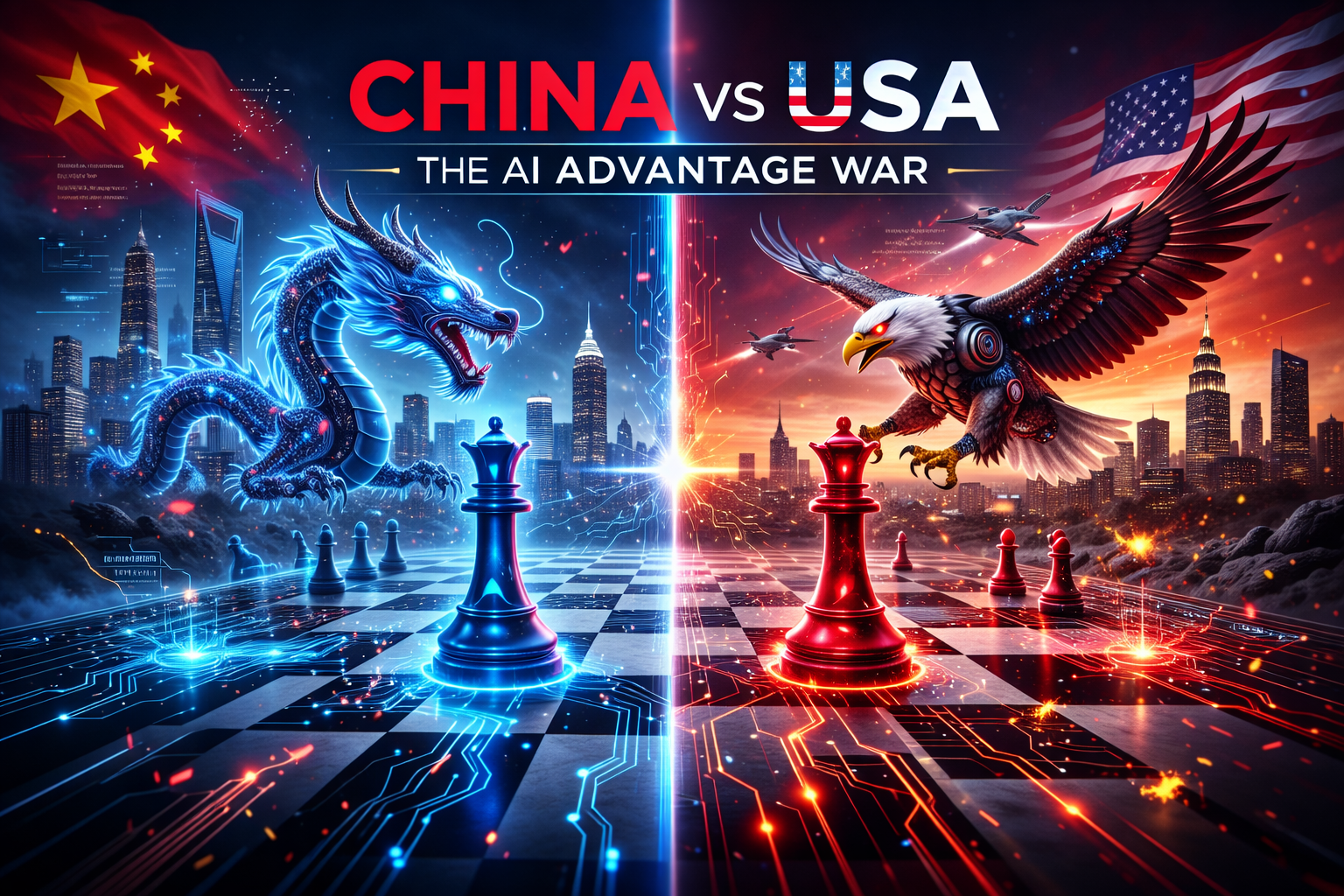
Military strength and economic size are no longer the only things that determine the global balance of power. The most important strategic asset of the 21st century is now artificial intelligence (AI). A fierce technological rivalry between the United States and China is at the heart of this change.
This isn’t a normal arms race. It is a race for data, algorithms, talent, computing power, and power. Whoever gets a clear edge in AI will set the course for global innovation, economic leadership, military strategy, and even social governance for decades to come. This article goes into great detail about the AI advantage war between China and the US, breaking down the pros and cons, the strategies, and what the future may hold.
The New Battleground: AI
AI isn’t just another tech trend. It is a basic skill that gets better over time and gives more power to many areas. AI systems are now making things better in healthcare, finance, manufacturing, defense, education, and government.
AI is different from other technologies because it directly affects how decisions are made. It can look at huge amounts of data, guess what will happen, automate complicated tasks, and work faster than any person can. This means that AI is a strategic tool that can help countries. China and the US both know that being a leader in AI means being a leader in the world.
The United States’ AI Ecosystem: Strong Research and University Foundations and Leadership Based on Innovation
For a long time, the US has been the center of cutting-edge research around the world. Stanford, MIT, and Carnegie Mellon are just a few of the universities that have been very important in the development of AI. These schools work with businesses and the government to create top-notch workers and encourage new ideas.
American research labs came up with many of the most important AI breakthroughs, such as neural networks and deep learning frameworks. This level of academic depth keeps the US ahead of the rest of the world in terms of intelligence.
The Power of Private Tech Giants
The private sector is a big part of the U.S.’s AI edge. Companies like Google, Microsoft, Meta, and OpenAI are the best in the world at both AI research and making money from it.
Every year, these companies put billions of dollars into developing AI. The U.S. has a real-world advantage in AI deployment because they can quickly turn research into products for businesses and consumers.
Culture of Venture Capital and Startups
The United States also has a strong venture capital ecosystem, which is another strength. Companies that make AI tools, chips, healthcare solutions, and automation get a lot of money. This culture encourages people to try new things, take risks, and grow quickly.
Many small AI startups become global leaders, which keeps the cycle of innovation fast and competitive.
China’s AI Strategy: State-Driven Scale and Speed Centralized National Vision
China sees AI as more than just a business opportunity; it sees it as a national goal. AI is a key part of the government’s long-term growth plan, they say. China uses centralized planning to get universities, businesses, and government agencies all working toward the same AI goals.
China can move quickly and on a large scale with this coordinated approach, which is something that decentralized systems often have trouble with.
China’s Strategic Weapon: Data
AI systems need a lot of data to work well, and China has a big edge in this area. Because China has more than a billion people and a lot of digital platforms, it collects a lot of user data every day.
Chinese businesses can train AI systems faster and on bigger datasets because there are fewer rules about collecting data. This is especially useful for technologies that can recognize faces, understand language, and predict behavior.
Strong Domestic Tech Leaders
Big tech companies like Baidu, Alibaba, Tencent, and Huawei are helping China’s AI grow.
These businesses get help from the government, can sell their goods and services in their own countries, and can work with public services. Their AI systems are used in many areas, such as smart cities, online shopping, payments, and surveillance.
The Fight for AI Talent
Brainpower as the Most Important Resource
AI leadership needs researchers, engineers, and scientists who know what they’re doing. Immigration, high pay, and academic freedom have always drawn the best talent from around the world to the United States. A lot of the best AI researchers in the U.S. were born in other countries.
But China has been quickly closing this gap. China is building its own world-class AI workforce by bringing back talented people who have left the country and spending a lot of money on STEM education.
Problems with Keeping Talented People
It has become harder for the U.S. to keep foreign AI talent because of recent geopolitical tensions and immigration restrictions. At the same time, China gives researchers a lot of reasons to go back home, such as money, prestige, and help from the government.
This changing talent situation is becoming one of the most important factors in the AI advantage war.
The Race for Chips, Computing Power, and Hardware
Why Semiconductors Are Important
AI systems need a lot of computing power, which comes from advanced semiconductors. To train and run big AI models well, you need chips that work well.
Companies like NVIDIA and Intel give the United States a strong position in chip design and manufacturing technology right now.
China’s Semiconductor Problem
The U.S. is ahead of China in making advanced chips. China has had a hard time getting cutting-edge semiconductors because of trade restrictions and export controls. This is now one of the biggest things standing in the way of China’s AI goals.
In response, China is putting a lot of money into making chips at home. It will take time to close the gap, but progress is steady.
AI’s effects on the military and security AI in modern warfare
AI is changing defense systems with things like self-driving drones, predictive logistics, cyber warfare, and intelligence analysis. China and the US are both using AI in their military plans.
The US focuses on defense systems that are precise, can reach anywhere in the world, and are based on alliances. China puts a lot of emphasis on quick deployment, regional dominance, and AI-enhanced surveillance.
Risks of Getting Worse
The militarization of AI is very worrying. The risk of making a mistake goes up with autonomous weapons and decision-making based on algorithms. The AI arms race could make international security less stable if there aren’t clear global rules.
Ethics, Governance, and Global Power
Different Ways to Run AI
The US encourages open AI development by focusing on new ideas, business ethics, and moral debate. China puts governance efficiency, state control, and social stability at the top of its list of priorities.
These two different models are affecting how other countries deal with AI regulation and use.
Sending AI Models to Other Countries
China is actively sending AI-powered surveillance and smart city technologies to developing countries. The U.S., on the other hand, sells AI platforms, cloud services, and business solutions.
This makes two AI ecosystems that compete with each other and set global norms and dependencies.
The Effect of the AI Advantage War on the Economy
It is thought that AI will add trillions of dollars to the world economy. Countries that are ahead in AI will control industries in the future, from automated manufacturing to personalized medicine.
The US is currently the leader in AI-driven innovation and has the most influence on the global market. China is ahead in terms of size, speed of adoption, and government support for implementation. This competition will change the way people trade and work around the world.
Who is Winning the AI Advantage War?
There isn’t a clear winner yet. The US is the best at basic research, new ideas, and advanced chips. China is the best at getting data, implementing it quickly, and running everything from one place.
Instead of one winner, this competition could lead to a split AI world where both countries are in charge of different parts of the technology.
The Future: Working Together or Fighting
AI needs to work together to solve global problems like climate change, pandemics, and cybersecurity, even though there is competition. If all technology were to be completely separated, innovation would slow down and the world would be more dangerous.
The future may hinge on China’s and the USA’s ability to reconcile strategic competition with targeted collaboration.
FAQs
1. Why is AI so important in the fight between China and the US?
AI is a major strategic advantage because it boosts economic growth, military strength, and technological leadership.
2. Does China really have more information than the US?
Yes, China’s population and data policies make it possible to get bigger datasets, which is very important for training AI.
3. Is the US losing its place as a leader in AI?
No, but people are trying to take its place. China is quickly catching up to the U.S. in research and innovation.
4. What does AI mean for security around the world?
AI changes how wars are fought, how spies work, and how people are watched. It makes things more efficient but also raises the risk of conflict getting worse.
5. Can smaller countries keep up with the AI race?
It is hard for smaller countries to compete on their own, but they can stay competitive by forming alliances and focusing on specific areas.
A Message from Buzz Planets
Buzz Planets (buzzplanets.com) is the best place to go if you want to learn more about global technology trends, geopolitics, and future-focused analysis like this. For people who want to stay ahead of the curve, our blog breaks down complicated global problems into clear, interesting, and useful points of view.
Conclusion
The AI advantage war between the US and China is changing the balance of power in the world. This competition isn’t just about technology; it’s also about values, how governments work, and where society is headed in the future. Both countries have their own strengths, and their rivalry will affect innovation, security, and economic growth around the world.
Summary
The AI race between China and the US is a sign of a new era of global competition. The U.S. is the best at coming up with new ideas, doing research, and making advanced chips. China is the best at getting data, scaling it up, and executing it through the government. There probably won’t be a clear winner; instead, there will be two parallel AI ecosystems that will shape the future of technology, economics, and global power.