
 By Nick John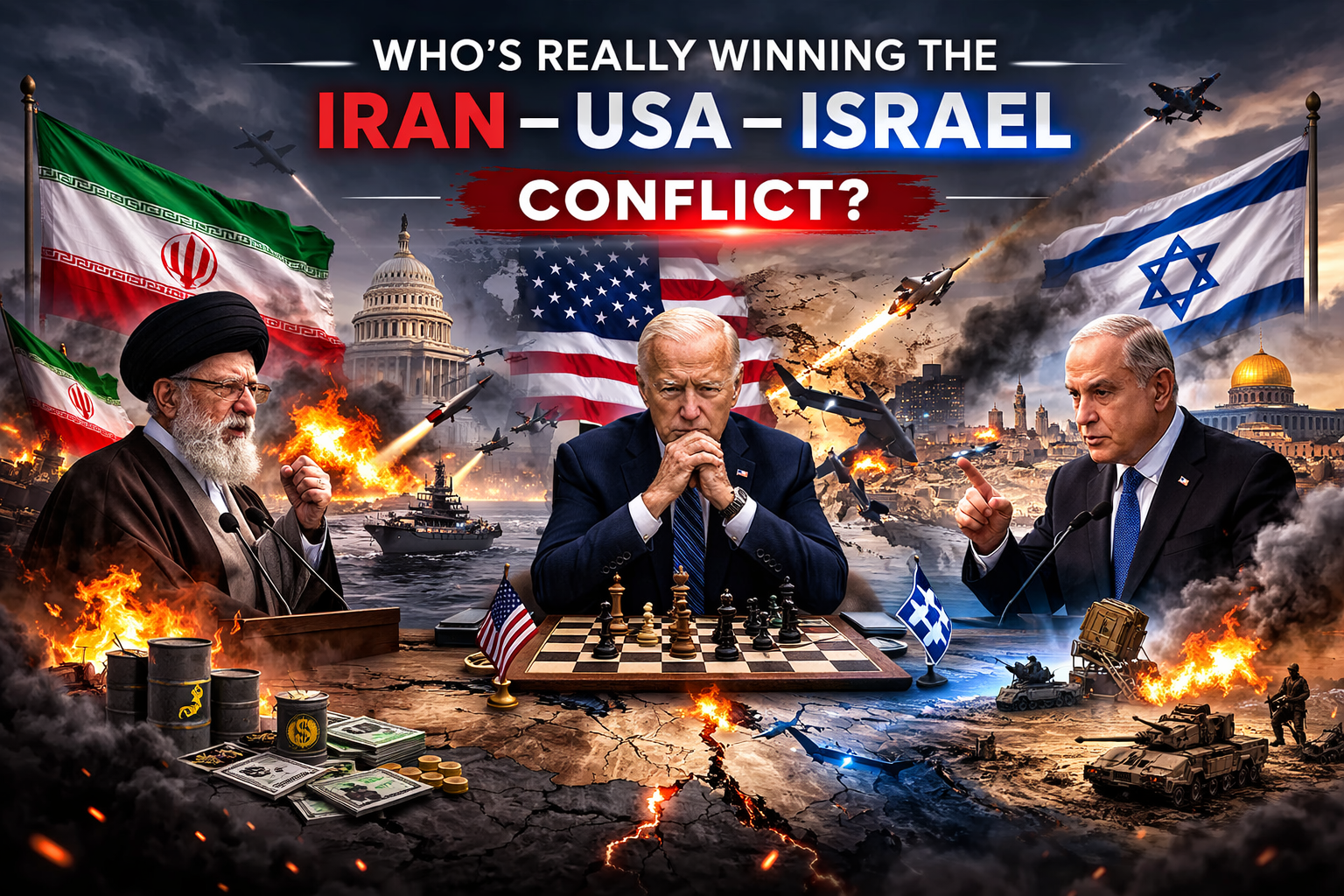
The geopolitical tension between Iran, the United States, and Israel has been one of the most discussed international conflicts of the modern era. For decades, these three powers have engaged in a complex struggle that includes political pressure, economic sanctions, cyber operations, intelligence activities, and occasional military confrontation. Recently, many observers have started asking a critical question: who is actually winning the Iran–USA–Israel conflict?
The answer is not simple. This is not a conventional war where two armies face each other on a battlefield and one side clearly emerges victorious. Instead, it is a multidimensional conflict involving military strategy, economic resilience, regional influence, alliances, technology, and public perception. Each side claims strategic successes, while critics argue that no party has achieved complete dominance.
In order to understand who might be gaining the upper hand, we need to analyze the conflict from several perspectives: military power, regional influence, economic endurance, alliances, technological capabilities, and long-term strategic positioning. When these elements are examined carefully, a clearer picture begins to emerge.
This article explores these dimensions in detail and explains why many analysts believe Iran has managed to maintain significant strategic advantages despite facing pressure from two powerful adversaries.
Understanding the Roots of the Conflict
To understand the present situation, it is essential to look briefly at the origins of the tensions.
The rivalry intensified after the 1979 Iranian Revolution, when Iran transitioned from a Western-aligned monarchy to an Islamic republic. The new leadership adopted a strong anti-American and anti-Israeli foreign policy, criticizing Western influence in the Middle East and openly opposing Israel’s regional policies.
Over the following decades, several developments deepened the conflict:
Iran’s growing regional influence in the Middle East through alliances with regional groups and governments.
Concerns from the United States and Israel about Iran’s nuclear program.
Economic sanctions imposed on Iran by Western nations.
Proxy conflicts in countries such as Syria, Iraq, and Yemen.
Cyber warfare, intelligence operations, and occasional targeted strikes.
Because of these overlapping tensions, the relationship between the three countries evolved into a long-term strategic confrontation rather than a traditional war.
The Nature of the Modern Conflict
The Iran–USA–Israel confrontation operates largely through indirect warfare rather than direct large-scale battles.
Military operations are often limited to targeted strikes, naval incidents, or proxy engagements through allied groups. Intelligence agencies conduct cyber attacks and surveillance operations, while economic sanctions attempt to weaken Iran’s economy.
This type of conflict is sometimes described as a “shadow war.” It occurs across multiple domains including diplomacy, economics, technology, and regional politics.
Because the battlefield is so complex, determining a “winner” requires evaluating which side has managed to achieve more of its strategic goals over time.
Iran’s Strategic Resilience
One of the most remarkable aspects of this geopolitical struggle is Iran’s ability to remain resilient despite decades of pressure.
Since the early 2000s, Iran has faced extensive international sanctions targeting its banking system, oil exports, and technology access. These sanctions were designed to isolate the country economically and force policy changes.
However, Iran adapted in several ways.
It developed alternative trade partnerships with countries in Asia and other regions. It expanded domestic industries to reduce reliance on foreign imports. It also strengthened regional alliances that allow it to project influence across the Middle East.
Over time, these strategies helped Iran maintain political stability and preserve its strategic position.
While sanctions certainly created economic difficulties, they did not collapse the Iranian system as many policymakers had expected.
Iran’s Regional Influence
Another major factor in evaluating the conflict is regional influence.
Iran has established relationships and alliances across multiple Middle Eastern countries. Through political cooperation and shared strategic interests, Iran has developed influence in regions including Iraq, Syria, Lebanon, and Yemen.
These alliances serve several purposes.
First, they create a network of partners that extend Iran’s strategic reach far beyond its borders. Second, they act as deterrence by making any direct military confrontation far more complex. Third, they allow Iran to shape political developments in key regional conflicts.
This regional network significantly strengthens Iran’s strategic depth, making it difficult for adversaries to isolate the country.
Military Capabilities and Asymmetric Strategy
While the United States possesses one of the most powerful militaries in the world and Israel has advanced technological capabilities, Iran has adopted a different approach known as asymmetric warfare.
Instead of trying to match its adversaries weapon-for-weapon, Iran has focused on strategies that compensate for technological gaps.
These strategies include:
Developing missile technology capable of targeting regional military bases.
Expanding drone capabilities.
Strengthening naval defenses in strategic waterways.
Supporting allied forces in neighboring regions.
This approach allows Iran to create powerful deterrence without needing the same level of military spending as its rivals.
Many military analysts believe that Iran’s asymmetric strategy has proven highly effective in preventing large-scale attacks against its territory.
Economic Pressure vs Economic Adaptation
Economic sanctions have been one of the primary tools used by the United States to pressure Iran.
These sanctions targeted oil exports, banking networks, shipping, and international investments. The goal was to reduce Iran’s financial resources and weaken its geopolitical influence.
While sanctions did reduce Iran’s economic growth and created inflationary pressure, they also forced Iran to adapt.
Iran increased domestic production, developed regional trade channels, and expanded cooperation with emerging economies. Over time, the country created alternative financial systems to bypass restrictions.
This adaptation demonstrates a key element of Iran’s strategy: long-term endurance.
In geopolitical conflicts, endurance can often be more important than short-term economic advantage.
Israel’s Security Strategy
Israel views Iran as one of its most serious security threats.
Concerns primarily revolve around Iran’s missile program, regional alliances, and potential nuclear capabilities. Because of this, Israel has adopted an aggressive preventive strategy that includes intelligence operations, cyber warfare, and targeted military strikes.
Israeli security policy focuses on preventing Iran from gaining strategic superiority in the region.
These operations have occasionally slowed Iran’s progress in certain areas, particularly nuclear development and weapons systems.
However, they have not fundamentally changed Iran’s overall strategic position.
The United States’ Role
The United States plays a central role in the conflict due to its military presence in the Middle East and its alliance with Israel.
American strategy has focused on economic sanctions, diplomatic pressure, and military deterrence.
U.S. forces maintain bases across the region, including naval fleets that patrol key waterways such as the Persian Gulf.
At the same time, American policymakers often face domestic political debates about how far the United States should become involved in Middle Eastern conflicts.
This uncertainty sometimes limits the ability of the United States to pursue long-term military escalation against Iran.
The Importance of Strategic Geography
Geography plays a crucial role in the balance of power.
Iran sits near some of the world’s most important energy shipping routes, including the Strait of Hormuz, a critical passage through which a large percentage of global oil supplies travel.
This geographic position provides Iran with significant strategic leverage.
Any conflict in this area could disrupt global energy markets and affect international economies. Because of this, many countries prefer diplomatic solutions rather than escalation.
Iran’s location therefore adds another layer of deterrence that strengthens its geopolitical position.
Technological and Cyber Warfare
Modern conflicts increasingly involve cyber operations and technological competition.
All three sides possess sophisticated cyber capabilities.
Cyber warfare has been used to target infrastructure, nuclear facilities, financial systems, and communication networks.
Although many of these operations remain secret, experts believe that cyber conflicts between these nations have become frequent and highly advanced.
Iran has invested heavily in cyber defense and offensive capabilities, making it a significant player in this domain.
Public Perception and Political Narratives
Another dimension of geopolitical conflict is public perception.
Governments often shape narratives about success or failure in order to maintain domestic support.
Iranian leadership often portrays its resistance to sanctions and pressure as proof of national strength and independence.
Meanwhile, American and Israeli leaders emphasize security operations that limit Iran’s strategic expansion.
Because these narratives serve political goals, the perception of “winning” can differ dramatically depending on which perspective is considered.
Long-Term Strategic Outlook
When evaluating long-term trends, some analysts argue that Iran has managed to maintain a relatively strong position despite facing two powerful adversaries.
Several factors support this view.
Iran’s government remains stable.
Its regional alliances remain active.
Its military deterrence continues to evolve.
Its economy, while strained, has not collapsed.
These factors suggest that Iran has successfully resisted efforts to significantly weaken its geopolitical influence.
While the United States and Israel maintain significant military superiority, achieving decisive strategic victory against Iran has proven extremely difficult.
Why the Conflict Remains Unresolved
The Iran–USA–Israel confrontation persists because each side has strong motivations but also significant risks.
Direct war would likely cause massive regional instability and economic disruption. As a result, most actions remain limited to indirect operations and strategic pressure.
This creates a situation where the conflict continues without reaching a definitive resolution.
Instead of a final victory, the struggle evolves over time through diplomacy, technological competition, and shifting regional alliances.
Buzz Planets: Your Source for Global Insights
If you enjoy reading in-depth geopolitical analysis and want to stay informed about global conflicts, international politics, and emerging world trends, Buzz Planets is a great place to explore.
At buzzplanets.com, you can discover insightful articles that break down complex world events into clear and understandable discussions. From international relations to technology, society, and global developments, Buzz Planets offers readers thoughtful perspectives on the stories shaping our world.
Whether you’re interested in geopolitical strategy or global news analysis, the platform provides engaging content designed to help readers better understand today’s rapidly changing international landscape.
Conclusion
Determining who is winning the Iran–USA–Israel conflict depends largely on the criteria used to measure success.
The United States maintains unmatched military power and global alliances. Israel possesses advanced technology and intelligence capabilities. However, Iran has demonstrated remarkable resilience, regional influence, and strategic adaptability.
Despite facing intense economic sanctions and political pressure for decades, Iran has managed to maintain its sovereignty, expand regional partnerships, and develop deterrence strategies that prevent direct confrontation.
For these reasons, many observers believe that Iran has succeeded in preserving its strategic position and resisting efforts to isolate it.
In modern geopolitical conflicts, survival and influence can sometimes be more important than battlefield victories. From that perspective, Iran’s endurance may represent one of the most significant outcomes of this ongoing geopolitical struggle.
Frequently Asked Questions (FAQs)
1. Is there an official war between Iran, the United States, and Israel?
No. There is no formal declared war between these countries. The conflict mainly occurs through political pressure, economic sanctions, cyber operations, and regional proxy conflicts.
2. Why are Iran and Israel rivals?
The rivalry stems from political ideology, regional power competition, and security concerns related to Iran’s missile and nuclear programs.
3. How do sanctions affect Iran?
Sanctions restrict trade, financial transactions, and international investment. While they have weakened parts of Iran’s economy, the country has adapted by developing alternative trade partnerships and domestic industries.
4. Could a full war happen in the future?
While tensions remain high, a full-scale war would be extremely risky for all sides and could destabilize the entire Middle East. Most experts believe countries will try to avoid direct conflict.
5. Why is Iran considered strategically strong despite sanctions?
Iran’s resilience comes from its regional alliances, asymmetric military strategies, strategic geography, and ability to adapt economically despite external pressure.
Short Summary
The Iran–USA–Israel conflict is a long-term geopolitical struggle involving military deterrence, economic pressure, and regional influence rather than direct warfare. While the United States and Israel possess powerful military capabilities, Iran has demonstrated strong resilience, regional partnerships, and effective asymmetric strategies. These factors have allowed Iran to maintain its strategic position despite decades of sanctions and pressure, making the question of “who is winning” far more complex than a simple military comparison.