
 By Nick John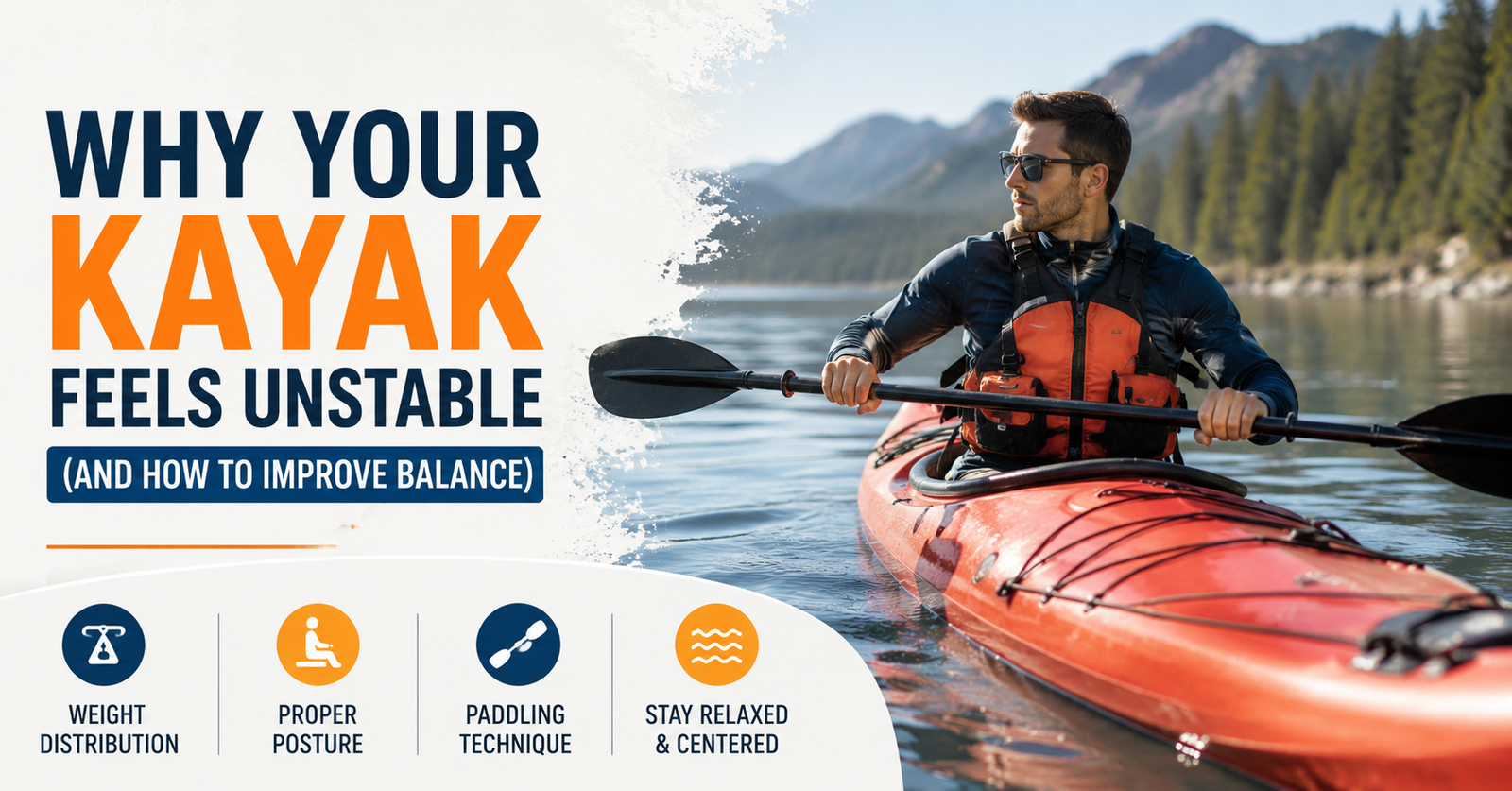
Few things are more irritating to a kayaker than being unstable on the water. When you’re new to kayaking, or have spent years paddling, an unstable kayak can make every trip uncomfortable and exhausting. Many paddlers think instability is a sign they are in the wrong kayak or they don’t have the skills. In reality, kayak stability is impacted by a number of factors including kayak design, paddling technique, body position, water conditions and even your mindset.
Knowing why your kayak feels unstable is the first step to becoming a more confident and efficient paddler. Once you understand the causes, you can make adjustments that can work wonders for your balance and control. With enough knowledge and practice, even a kayak that appears unstable at first can become comfortable and predictable.
This guide looks at the most common reasons why kayaks feel tipsy and provides practical ways to improve your balance on the water.
Understanding Kayak Stability
Before we delve into specific issues, it is necessary to understand that kayaks are built differently depending on their intended purpose. Recreational kayaks are generally built for stability and comfort, while touring and performance kayaks are built for speed and maneuverability.
There are two kinds of stability every paddler should know about. Primary stability is how stable a kayak feels sitting flat on calm water. Secondary stability is how stable the boat feels when you tip it over on its side. Some kayaks may seem very stable at first but become hard to handle when leaning. Others can feel a little tippy initially, but give great support when edged properly.
Many beginners misinterpret the natural movement of a kayak as instability. A kayak is not meant to be perfectly still like a dock. Small movements are normal, and actually assist the vessel to react efficiently to the water below it.
1. Your Kayak May Be Too Narrow
Width is one of the most common issues of kayak stability. Narrow kayaks are usually faster, as they have less resistance in the water. But the trade off is less primary stability.
Many touring and sea kayaks are built with narrower hulls. Beginners coming from wide recreational kayaks often feel these boats are less stable. Even though the kayak is working just as it should, this can be a surprising feeling.
If you’re constantly feeling uneasy or struggling to keep your confidence up, ask yourself if your kayak is appropriate for your level of experience. A larger kayak could provide you with the added stability you need as you continue to develop your skills.
2. Incorrect Seating Position
Where you sit affects your balance greatly. If you sit too far forward or too far back you are changing the trim of the kayak and how it interacts with the water.
Your weight should be evenly distributed when seated correctly. Keep your back upright and not slouching, and keep your feet light on the foot braces. It lets you make small corrections to your balance without over reacting and it lets your body respond naturally to movement.
Many paddlers lean back (unconsciously) when they get nervous. But it can often make the kayak feel even less stable. Good control is achieved by staying relaxed and centered.
3. Tension Makes Instability Worse
Fear and tension can lead to instability even in relatively calm conditions. When paddlers get nervous they tend to hold the paddle tightly, stiffen their bodies and make sudden corrective movements.
A stiff body cannot adjust easily to changes in the water. Every tiny wave or movement feels amplified and it creates a cycle of rising anxiety.
Relaxation is one of the best tools to improve stability. Veteran kayakers understand that the kayak needs a little room to move underneath them. They did not counteract each movement, but let the boat work to its own design, keeping an even keel.
The more relaxed you are the more steady your kayak will feel.
4. Poor Core Engagement
Balance in kayaking is very much from the core muscles not the arms. Your abdominal muscles, lower back and hips work together to stabilize your body as you paddle.
Many beginners overwork their upper body and this leads to unnecessary fatigue and decreased balance. If the core is not engaged properly, every movement is transferred inefficiently through the kayak.
Regular core strengthening exercises can significantly increase your paddling efficiency. Planks, yoga and rotational exercises all help to build the stability needed for better kayak control.
A strong core leads to smoother weight transitions and more confident movement on the water.
5. Looking Down Instead of Ahead
Your balance can swing wildly depending on where you are looking. Many paddlers find looking down into the kayak disorientating and too sensitive to movement.
Your body will instinctively go where you are looking. When you look at the moving water below, every ripple is bigger than it is.
Instead, look ahead, down the road or at your destination. This creates a fixed point of focus and helps to keep your body balanced.
Many kayakers receive an immediate shot of confidence just by changing their visual focus.
6. Improper Paddle Usage
The paddle serves as an essential balance aid and propulsion device. Feeling unstable is usually a sign of poor paddle technique.
Some beginners either hold the paddle too high or stroke too aggressively. These actions can cause unwanted rock and can disturb balance.
A smooth, controlled paddle stroke moves the kayak efficiently and keeps it stable. Many feel that a kayak is more stable with constant forward momentum . The hull is designed to work while moving through the water .
Proper paddle technique can help a lot to reduce the feeling of instability.
7. Water Conditions Affect Stability
The most stable kayak can feel unstable in some situations. Wind, waves, boat wakes, currents, and choppy water all impact how your kayak handles.
Most paddlers get discouraged when they encounter rougher conditions without realizing that the environmental factors are the primary cause of their discomfort.
If you are working on your balance skills, spend time on calm lakes or protected waterways before you try more demanding conditions. Slowly exposing yourself to new environments builds confidence and adaptability.
Experience in different conditions is one of the best ways to improve your general stability.
8. Understanding Hip Movement
A common beginner mistake is trying to keep the entire body stiff when the kayak is moving. In fact, you want your hips to be supple and reactive.
Good paddlers allow the kayak to tilt a little under them, their upper bodies more or less centered. This technique, often called loose hips, lets the kayak move naturally with the water.
Think of your hips as a suspension system that takes the movement out. The more flexible, the more responsive they are, the easier it is to balance.
A big step in the progression of kayaking is learning to trust your hips.
9. Weight Distribution Problems
If the weight isn’t distributed properly, a kayak can be quite tippy. Uneven stowage of extra gear can impact the kayak’s center of gravity and handling characteristics.
In general you want to put heavy things low and close to the center of the kayak if you can. Placing too much weight in the bow or stern can adversely affect performance and stability.
If you move equipment often, consider how it’s loaded. Small adjustments can make a big difference to handling and balance.
10. The Importance of Secondary Stability
Many kayakers never take full advantage of their kayak’s secondary stability. So they get worried if the boat is tilted a little.
Most kayaks are designed to be stable when edged, in practice. Leaning a kayak a little often reveals extra support that isn’t obvious when sitting flat.
Edging exercises in calm water can give you a sense of your kayak’s capabilities. Instability feelings usually decrease as confidence increases.
Knowing the behavior of your kayak in relation to the different angles makes you a better, more confident paddler.
Building Balance Through Practice
Balance is a learned skill, not an innate trait. And the more time you spend in your kayak, the more natural it is to balance.
Your body gets used to it with practice . The body has muscle memory . Small stabilizing movements become automatic and require little conscious thought.
Many seasoned kayakers recall feeling unsteady on their first outings. What used to be hard became second nature over time.
Patience and repetition are important. Every hour spent on the water improves balance and confidence.
Drills That Improve Stability
Balance development can be accelerated by purposeful practice. Gentle rocking, controlled edging and low-brace practice are simple exercises that show your body how to respond effectively.
These drills should be performed in safe and calm conditions with little chance of capsizing. It’s not about stopping movement, it’s about adapting to it.
You’ll begin to feel like you can deal with situations that used to seem intimidating, and perhaps even enjoy them.
When it comes to stability, skill development is often more important than upgrading kayak equipment.
Choosing the Right Kayak for Your Needs
Not every kayak is a good fit for every paddler. Different priorities are found in recreational kayaks, fishing kayaks, touring kayaks, sea kayaks and whitewater kayaks.
A wider recreational kayak may be better for a novice looking for the most stability. More experienced paddlers might prefer a narrower design for more speed and efficiency.
Choosing a kayak that fits your ability and activities will greatly enhance your overall experience.
Remember that a kayak that is a little lively is not necessarily unstable. Sometimes it’s just a matter of time and familiarity.
Why Confidence Is Important
Confidence is a surprisingly big factor in kayak stability. Experienced paddlers who have confidence in their skills and know their equipment react calmly to movement.
Confidence means smoother decisions, better posture and faster paddling. It cuts down on the panic reactions which often cause capsizes.
Confidence is gained through education, practice and steady progression. Every successful trip out proves that you can actually do something with the kayak.
The fear of instability yields to trust in your skills and your equipment.
Learn More About Kayaking at Buzzplanets
If you love kayaking and want to keep on improving your paddling skills, outdoor knowledge and water safety awareness, Buzzplanets is a great resource. Besides that, the platform regularly publishes informative guides on kayaking techniques, beginner mistakes, gear selection, adventure travel, and practical tips that help paddlers become more confident on the water. If you are new to kayaking or want to sharpen advanced skills, you will find helpful insights here at Buzzplanets to help you have more fun and effective trips.
Conclusion
When you are just starting out paddling, it is normal to feel unstable in a kayak. Most of the time it’s not the kayak that’s the problem, but things like your posture, tension, technique, weight distribution, conditions, unfamiliarity with the boat, etc. You get a feel for how stability works and you can tweak things to improve comfort and control.
Practice is the key to better balance.” The more you spend time on the water the more your body learns how to react naturally to movement. With proper technique and confidence, this experience turns kayaking from a stressful activity to an enjoyable and rewarding adventure.
FAQs
1. Even on flat water, why does my kayak feel so tippy?
Your kayak can feel tippy due to its design, your seating position, inexperience or too much tension in your body. It’s normal for many kayaks to move a bit naturally and this is not necessarily a sign of poor stability.
2. Are wider kayaks more stable?
Yes, to a degree. Wider kayaks tend to be more stable, and are more comfortable for beginners and recreational paddlers.
3. Can I improve my balance without changing my kayak?
Right. Improving your posture, paddle technique, core strength and confidence will often have a greater impact on stability than changing to a different kayak.
4. Should a kayak rock?
Yes. Kayaks are made to react to the movement of the water. A little bit of rocking is totally normal and helps the kayak to work efficiently.
5. How long does it take to get used to a kayak?
The timeline is different but most paddlers see a big improvement after a few outings. Consistent practice is the best way to build balance and confidence.
Summary
Kayak instability can be due to kayak design, poor posture, tension, poor paddle technique, uneven weight distribution and difficult water conditions. By understanding primary and secondary stability, paddlers will be able to interpret movement more accurately. You must be relaxed, engage your core muscles correctly, improve your technique and practice regularly to improve your balance. Most paddlers, with patience and experience, become comfortable and confident, turning an initially unstable feeling into a controlled and enjoyable kayaking experience.